

The Betz Sphere
Updated: 6 days ago
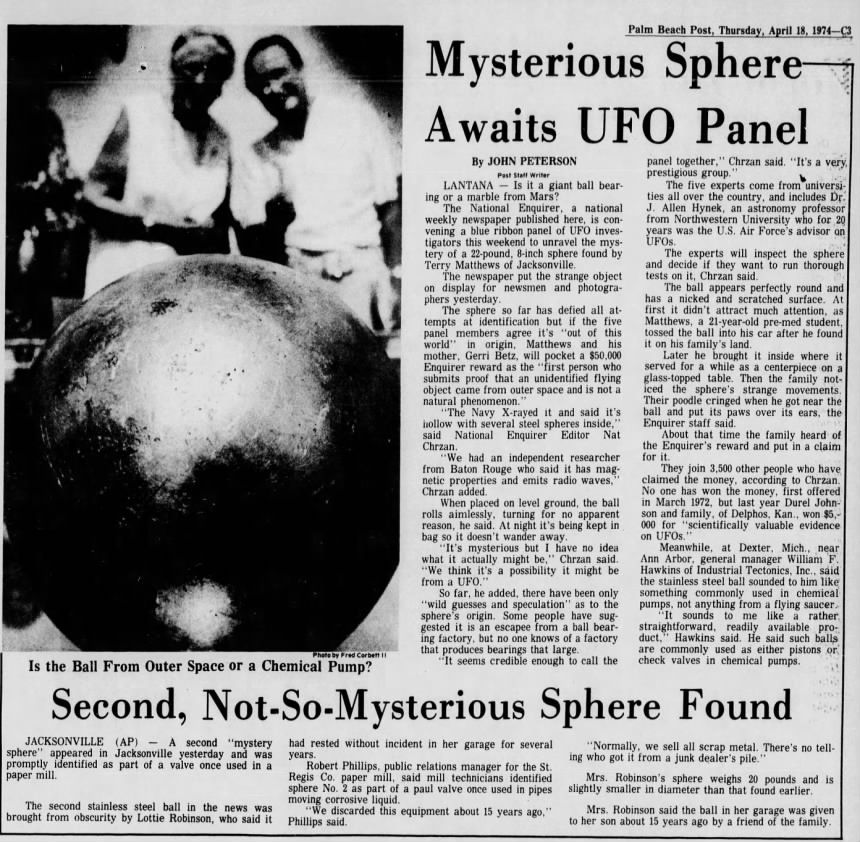
Sometime in March 1974, the Betz family discovered a metal sphere on their property on Fort George Island in Jacksonville while investigating the aftermath of a small brush fire.
Partially exposed in the scorched earth was a smooth metallic sphere, roughly the size of a bowling ball. It had no seams, no markings, no visible openings—nothing to indicate how it had been made or what it had once been used for. The family, Antoine, Jerri, and their son Terry, turned it over in their hands and, lacking a better explanation, assumed it could be a cannonball and brought it home.
Several days later, twenty-one-year-old pre-med student Terry noticed that the sphere appeared to react to sound while he was playing guitar. We do not know what he was playing, but as it was 1974, I like to imagine it was something by Jacksonville’s own Lynyrd Skynyrd. It produced a faint vibrating or throbbing noise. Soon after, they reported that the sphere would roll across the floor on its own, stop, and change direction, occasionally returning toward people after rolling away, as if correcting its path.

At times, it vibrated audibly, producing a high-pitched tone that reportedly caused nearby dogs to whine and recoil. The sphere was placed inside a bowling ball bag in an effort to contain the unexplained. Like many reported anomalies, these events appeared intermittently—what happens once can be doubted. What happens repeatedly, but irregularly, occupies a space in a foggier dimension.
By mid-April, local newspapers had begun covering the object. Within weeks, national and even international outlets picked it up.
Visitors came to the Betz home to witness the object firsthand. Reporters described demonstrations in which the sphere appeared to move in response to slight inclines, vibrations, or nearby activity—though never with the consistency one would expect from a controlled mechanism. The sphere was alternately described as extraterrestrial, experimental, or even sentient, labels that adhered less to the object itself than to the cultural moment in which it appeared. The early 1970s, suspended between post-Apollo optimism and Cold War unease, proved fertile ground for interpretations that blurred the line between technology and visitation.

The U.S. Navy was granted temporary access to the sphere under a contract written by Jerri Betz herself. The agreement allowed the Navy to study the object at Naval Station Mayport for two weeks, with the condition that it be returned if it was not government property. After X-ray and metallurgical tests, it was determined to be stainless steel with a 1/2-inch shell, measuring 7.96 inches in diameter and weighing 21.34 pounds.
Scientists later examined the sphere as well, including Dr. J. Allen Hynek, creator of the “Close Encounter” classification system that we all know and love, who was in New Orleans for a meeting with the National Enquirer, which was establishing a $50,000 prize for definitive proof of extraterrestrial life. Since Hynek and several other scientists on the Enquirer’s panel were all there, Terry Betz and the sphere were reportedly taken by private plane to ensure its safe arrival and secure return. Their conclusions aligned with the Navy’s: the object was man-made.
The vast difference in accounts, newspaper reports, internet articles, and podcast deep dives pushes the conclusion of the sphere’s story toward what is, I believe, the best ending—that thrilling, spine-tingling, favorite line of the externally curious: “We may never know,” standing in place of the metal mystery ball that we cannot reexamine for a 2026 analysis, as it is nowhere to be found.
This is not to say that there are not a healthy number of possible explanations from investigations past and nearpresent, many noting that the sphere’s specifications align with industrial ball check valves. A stainless steel ball manufactured by Bell & Howell, when weighed and measured, was reported to match the Betz sphere almost exactly, according to a 2012 Skeptoid podcast analysis, along with the account of James Durling-Jones, who recognized the object as identical to spheres he had used in his sculptures. He had transported them on the roof of his car through the Jacksonville area years earlier, stating that some fell off along the way—one of which may have remained on Fort George Island until the Betz family found it. These are but a sampling of explanations offered by those who recognized the sphere as an object of the everyday, setting the unusual behavior reported aside.
We can place the Betz sphere in a broader category: objects that are clearly physical, clearly real, but not immediately understood. An uncommon phenomenon, made even more rare by the emergence of applications that can identify almost any image or find relevant information based on its description so quickly that we need not suppose or imagine. All hope and wonder are not lost, though. To uncover such an object is the expected mystery within archaeological research—that land wherein the questions “What is it?” and “Where did it come from?” still live.
One of the oldest examples of this is the Roman dodecahedron. Found across parts of Europe and dating back to the 2nd or 3rd century CE, these small bronze objects have twelve pentagonal faces, each with circular holes of varying sizes. Many also feature small knobs at each vertex. Despite decades of study, there is no consensus as to their purpose.

It is supposed that they may have been tools, ritual objects, instruments for measurement, or even artifacts of play. The dodecahedron might have been one component of a larger machine, placed within the same theoretical shelf as the one on which our odd ball sits.
Mystery objects like the Betz sphere are the perfect example when posing the question: What will the remnants of our civilization cause our descendants—or those who will one day descend upon our planet—to suppose about us based on what they find?
Perhaps they will find objects whose purposes are obvious.
Perhaps they will find others that resist explanation, even with all the tools available to them. May we leave them as many mysteries as were left to us, and may they confuse, capture, and connect those future finders lucky enough to happen upon them.


