Polk's Citrus History & Grand Celebrations
Many remember the time during January – as citrus season is fully manifest – Winter Haven would host a grand celebration featuring parades, banquets, nationally broadcast radio and television shows, massive displays of fresh fruit, and carnival shows such as the James E. Strates company with rides (including the double Ferris wheel) overlooking Lake Silver.

The celebration was born in 1924 as the Polk County Orange Festival. The Orange Festival was the brainchild of Dr. R. A. Nichols, pastor of the Christian Church in Winter Haven. He had been a lecturer for several years on the Chautauqua Circuit (a traveling tent show in the early 1900s that brought cultural programs such as lectures, music, and plays to remote areas of the country). He witnessed the crowds at many county fairs and was reminded of their popularity when he happened across an article about the Portland, Oregon Rose Show. Dr. Nichols took his idea to the Winter Haven Chamber of Commerce, which at the time had a considerable membership for a town of 2,000 people. The Chamber immediately embraced the concept, and four months later, the first Orange Festival was held on January 22, 23, and 24, 1924.
The first Festival Director was Frank J. Senn, a citrus grower. The celebration attracted about 170 booths that were housed in tents or temporary wooden structures around the perimeter of Central Park. It had a very “orange” focus and the most elaborate displays were devoted to citrus.

In the early 1930s, the festival would move to Third Street, NW setting up from the current city hall property to Lake Silver Drive. The current site of the City Government Annex and the Trailhead Park featured four long linear halls (Orange, Grapefruit, Tangerine, etc.) that housed the annual exhibits and fresh fruit displays. With the exception of World War II (when the buildings housed German prisoners of war), the festival was held in that location until moving to the Orange Dome in 1965.
That first festival featured a parade with 20 floats and the 116th Field Artillery Band of the Florida National Guard. Three hundred and fifty dollars was distributed in prize money for the top three floats and $25 for the best clowns.
Festival events featured popular competitions of the day including a three-legged race, needle-threading contest, potato race, rope pulling contest, greased pole, pig contests, and a school children’s parade with a $5 prize for the best impersonation of Jackie Coogan.
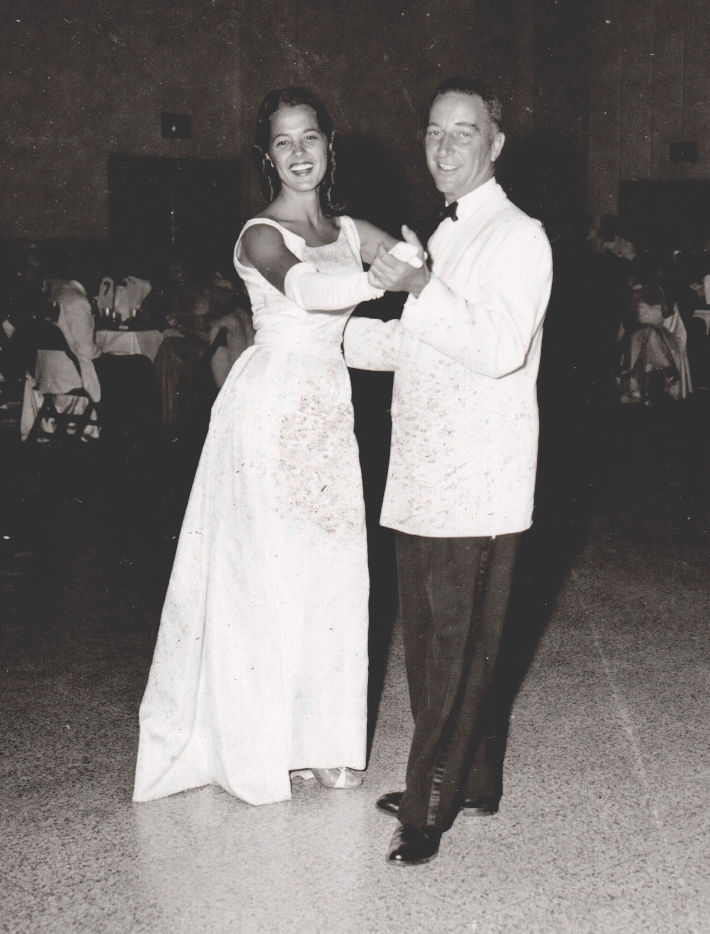
The Festival closed with the Coronation Ball honoring the Orange Queen and, for the one and only time in its history, an Orange King. (Note: The Queen later became Miss Florida Citrus, and the pageant was discontinued in 2003.)
It was estimated that the three-day show drew 10,000 people and that was significant for Winter Haven’s size. It was a financial success, too.
A description of the city from the first festival program notes Winter Haven “has a fine fire department with full equipment, an efficient police force, a strong Chamber of Commerce numbering 700 members, a Women’s Civic League, Red Cross Chapter, seven churches, eight fraternal societies, fine grade and high school buildings, an efficient faculty and a large student body, three banks with $3 million in resources, a $110,000 mausoleum and scores of modern up-to-date business houses of every description.” The total valuation of Winter Haven was estimated at $10 million (2015 estimate: $1.6 billion).

For more than eight decades, Winter Haven was home to a grand celebration of the citrus industry. Though discontinued in 2008, in its heyday, the event brought Polk County and Florida national publicity.
Before there was television, the best visual way to get your information was movie theater newsreels. Pathe News was one of the foremost, and they visited the second Orange Festival filming in 1925. International Newsreel filmed the Festival in 1929 when it evolved from a local to state event. In 1935 and 1936, NBC radio covered the event on its then famous “Farm and Home Hour.”
Radio coverage continued through subsequent years, but it was not until 1941 that the first celebrity went on the air from the Festival. Mary Margaret McBride, who had become famous for her nationally broadcast programs, provided her audience with a lush description of life in Florida including recipes that required oranges.
In 1947 Johnny Olson, a popular Chicago radio emcee, brought “Ladies Be Seated” (LBS) program to the Citrus Exposition beginning a remarkable eight-year run. LBS was a highly successful daytime audience participation show carried on 202 stations by the Mutual Broadcasting Network. The program was the first of many to be broadcast live from the amphitheatre stage on the shores of Lake Silver. The following year, the show’s primary host, Tom Moore, came to Winter Haven and fell in love with Florida. Moore became so attached to the Florida climate that in 1955 he abandoned Chicago, came here, and developed a new broadcast known as “Florida Calling.”

Other popular radio programs that broadcast from the Exposition included Tom Malone with the “Westinghouse Hour” and Eddie Dunn with “Once Upon a Star.”
Television arrived and the Citrus Exposition moved to capitalize on its popularity. “The Garry Moore Show” and “I’ve Got a Secret” with Moore as host, were firsts, staged in the Lake Silver Amphitheatre with stars such as Jayne Meadows, Faye Emerson, Henry Morgan, Bill Cullen, Durward Kirby and Rocky Graziano. The year was 1957. They would return four years later in 1961. The second visit brought Bess Myerson, Debbie Reynolds, Betsy Palmer, Alan King, Diana Dors, Marion Lorne, Peter Lawford, and a newcomer rocketing to stardom ... Carol Burnett.
Other Exposition television moments included “Queen for a Day,” “The Jimmy Dean Show,” “Charge Account,” “Supermarket Sweep,” “You Don’t Say,” and “The Mike Douglas Show.”
While many of the early shows used the amphitheatre and Nora Mayo Hall, Mike Douglas taped five 90-minute segments during the 1967 and 1969 Festivals. Among the stars to appear were Van Johnson, Michael Landon, Totie Fields, Buster Crabbe, Jack Carter, June Allyson, Joey Hetherton, the McGuire Sisters, Cliff Arquette, Skitch Henderson, Doug Sanders, Mohammed Ali, Gloria DeHaven, and citrus spokesperson of the time, Anita Bryant.
Now you know where Nick Christy got all those pictures that were displayed in the Sundown restaurant’s foyer.
The cumulative national publicity that originated from the Citrus Festival is immeasurable.
In 1947, the Lake Silver Amphitheatre was constructed and in 1949, the Florida Citrus Building and venerable Nora Mayo Hall were built. About this time, the name was again changed to The Florida Citrus Exposition, and the event continued on that site until 1964.
Following the 1964 Exposition, the Festival Board of Directors voted to relocate to a 57-acre site on Cypress Gardens Boulevard. The site was also to host the Boston Red Sox spring training in the newly constructed Chain of Lakes Stadium complex.
The board also voted to change its name to the Florida Citrus Showcase and announced plans to construct a geodesically designed circular structure 170 feet in diameter on the city-donated property. It was estimated to be capable of accommodating 3,000 people.

The “golden-domed” building, as it was promoted in early descriptions, would rise 55’ high and encompass a 23,000 square foot area. The Dome was referred to as Florida’s most unusual building.
The site was host to the 1965 Citrus Showcase in March of that year. In addition to its unusual design, the Dome housed an 8-inch-by-16-inch stainless steel time capsule that tells the 44-year history of the Festival/ Showcase to that point. Contained in that capsule is a fresh orange, tangerine, and grapefruit wrapped and sealed in such a way that the fruit is supposed to retain its power to germinate until the time capsule is scheduled to be opened in 2065. That capsule now resides at Florida Southern College.
While the Showcase site has fond memories for many, others felt the celebration was never quite as grand as when first held downtown. Over the years, “fresh fruit displays” became more and more difficult to attract.
The industry was moving from fresh fruit to concentrate and on to notfrom-concentrate juice. The Dome was a large, cavernous building with mind-numbing echoing acoustics. It originally was to have two smaller domes constructed, one to the east and west for exhibits, but the festival struggled more each year to survive. Disastrous freezes of the late 80s forced a lot of citrus to the south, and the show became far more carnival and far less citrus-oriented.
In the 1990s, the event moved yet again to a new building adjacent to the Auburndale Speedway but financial problems forced a return to the Orange Dome site before decades end. By 2008, the Citrus Showcase was history.
The Orange Dome ... landmark, acoustical nightmare, hurricane refuge, eyesore - everyone had an opinion ... and, as time marched on, was demolished in 2012. The late Paul Cate, community activist and former Mayor of Winter Haven, said there was only one thing the Dome lacked ... about six good sticks of dynamite! As it was, just one relatively small crunch from a backhoe brought the entire dome down in less than 13 minutes.