

The Afterlife of Dr. Paul Bearer

For the readers long ago who embarked on the journey through Dante Alighieri’s vision of the darkest steps of Hell, they found themselves guided by the poet Virgil. For listeners in the classic Golden Age of radio, it was Raymond who led them behind the creaking door of the Inner Sanctum, and for the watchers of late-night television in the ’60s through the ’80s—in some lucky cases, even later—their trip into the dark often began and ended with their local horror host.
Our trips into the dark, into the lands of monsters, B-movies, silly movies, and wacky-pack jokes were prescribed by a doctor by the name of Paul Bearer—Dr. Paul Bearer. His tenure in the Tenement Castle was longer than that of most regional television horror hosts in the country, and he is remembered as one of the most enduring horror hosts in television history, best known in Florida for hosting WTOG’s Creature Feature. That I can say this story is not over is a Halloween to hearts that celebrate all year long.
Dr. Paul Bearer was created and portrayed by Ernest Richard “Dick” Bennick, who first brought the character to television in North Carolina before carrying him south to Florida. Beginning September 15, 1973, Bennick hosted WTOG’s Creature Feature, remaining associated with the station and the character until his death in 1995. The 22- year run established Dr. Paul Bearer as a fixture of Tampa Bay television, reaching viewers far beyond St. Petersburg and becoming familiar to generations of Floridians who spent their Saturday afternoons in his company.
The road that brought Dr. Paul Bearer to Florida had begun years earlier, during a period when monsters that belonged to an earlier generation of moviegoers were finding new audiences on television. In 1957, Screen Gems prepared 52 Universal pictures for television syndication under the wonderfully direct name Shock! Among them were Frankenstein, Dracula, The Invisible Man, The Mummy, and other horror, mystery, and suspense pictures from Universal’s library. The surviving Screen Gems exhibitor book prepared for the package contains images, synopses, news releases, and promotional ideas for the 52 movies, supplying local stations not only with films to broadcast but with suggestions for building an event around them. Television needed programming, and Hollywood studios had decades of it. Movies produced for theatrical audiences in the 1930s and 1940s were now entering American homes, where children born long after their original releases encountered Bela Lugosi, Boris Karloff, Lon Chaney Jr., and the visual vocabulary of Universal horror as something simultaneously old and new. The monsters could now arrive in the living room on an ordinary afternoon or late at night, their theatrical lives beginning again on a smaller screen.
The promotional material for Shock! included sections devoted to “SHOWMANSHIP,” “SALES PROMOTION to enthuse your sponsors,” and “AUDIENCE PROMOTION to excite your public.” A station preparing its premiere was encouraged to arrange a Shock party inside its own studio or, if possible, in a haunted house. “Be sure the setting enhances the appeal of the pictures themselves with every kind of ghoulish prop imaginable,” the brochure advised, before adding another practical suggestion: “If you can, borrow a coffin to add to the mood.”
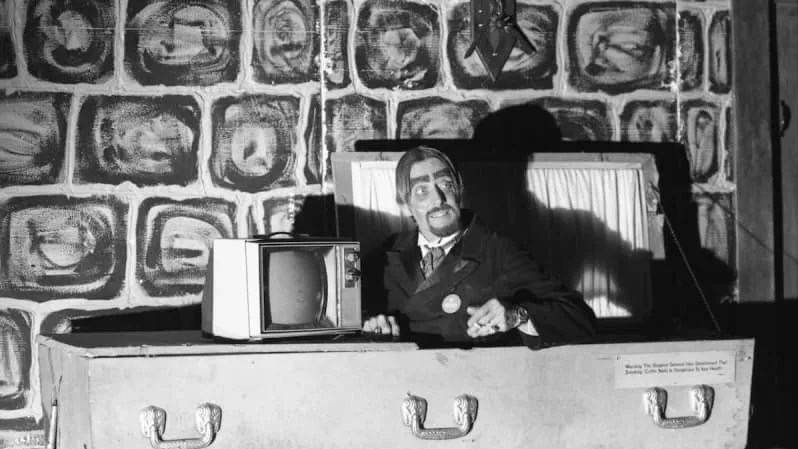
The monsters could leave the television studio too. Screen Gems suggested a “FIND THE SKELETON” contest in which viewers followed clues to a skeleton hidden somewhere in the community, while a mummy might “escape” from a local museum just in time to meet waiting reporters and photographers. A monster and a girl in Charles Addams-style makeup could even travel through town in a flower-covered hearse, stopping along the way to distribute membership cards for the “Monster Society of America.” Local news programs could interview a different monster each day before the premiere, making the creatures part of the television station and its community before the old movie had even begun.
The arrival of Shock! coincided with one of the peculiar possibilities of local broadcasting. Stations in different cities might purchase the same films, but everything surrounding the movie could be created locally. The sets, announcers, contests, comedy, advertisements, characters, and promotions could belong entirely to the community watching them. The host became one of the most memorable parts of that arrangement, waiting outside the movie to welcome the audience in and then returning during breaks to keep them company.
Bennick entered that tradition with years of radio behind him. His career began in radio, where he developed the skills of a “boss jock,” and expanded into stage magic, television, and live entertainment. In his extensive August 1991 interview with Ed Tucker, conducted at Bennick’s Winter Haven home, he remembered beginning at a Charlotte radio station in 1949 and later moving to Winston-Salem, where he became a successful disc jockey, held record hops, and ran a teenage dance club. Television brought interview programs, weather, and a teenage dance show, and Bennick developed the habit of volunteering whenever another opening appeared at the station.
By the mid-1960s, he was working in television at WGHP in High Point, North Carolina, where he became involved with the station’s Shock Theatre. Bennick remembered a Saturday-night horror program whose presenter lacked a consistent character or set, sometimes dressing differently and appearing against whatever surroundings happened to be available. Having been, in his words, “a horror nut all my life,” Bennick wanted to try something more definite. “I felt if we had a definable character and a definable set there was a better chance of gaining an audience from this,” he recalled.
His first experiment was Count Shockula, a skeletal figure Bennick quickly realized was not connecting with viewers. He redesigned the act, drawing upon his interests in magic, old horror movies, costuming, acting, and puns, as well as the pages of his collection of Famous Monsters of Filmland. The replacement became Dr. Paul Bearer, and Bennick later remembered the ingredients simply: “You bring all this into play and this is what comes out in Dr. Paul Bearer.”
Bennick was already known on radio and wanted the character to sound separate from the disc jockey his listeners recognized. He did not consider himself particularly good with dialects, so he developed what he called a “reverse falsetto,” moving his voice downward instead of upward. The resulting gravelly sound joined the scar, center-parted hair, frock coat, spats, and makeup as parts of a character that would remain recognizable for decades.

Bennick called himself “a sound effects freak” because of his radio background. He heard a doorbell effect in an old Roger Ramjet cartoon playing at the studio and immediately wanted it for the show. He constructed the sound of the coffin opening by splicing two creaks together, while the familiar scream came from a North Carolina cameraman who had recorded one especially enthusiastic attempt years before.
The Three Stooges, Groucho Marx, Mad Magazine, and Charlie Chaplin all contributed something to Bennick’s approach. Inside the Tenement Castle, he could distort familiar products, talk to strange characters, take ordinary expressions literally, alter the titles of books and magazines, and produce special prerecorded segments. The world remained consistent because Dr. Paul Bearer did not behave as though any of it were strange. As Bennick explained it, “Dr. Paul Bearer’s world is very real to him; it’s everyone else who is out of step.”
Bennick was a monster kid himself before generations of younger monster kids knew his face. His Famous Monsters collection helped him assemble Dr. Paul Bearer, and eventually the magazine turned its attention back toward him with an article that appeared in Famous Monsters of Filmland No. 144 in June 1978, capturing Dr. Paul Bearer while he was still relatively early in what would become his decades-long Florida run. The magazine introduced its Florida horror host with the same sort of language that filled the Tenement Castle, describing him as an “MC (Madly Crazy)” and warning readers about the extraordinary number of puns awaiting them. Dr. Paul Bearer greeted his television audience in the article with, “Good evening, fright fans… I’ve been lurking for you,” adding that Halloween was Dr. Paul Bearer’s “biggest & best horrorday,” when Bennick climbed into his 1963 Cadillac hearse to make between 25 and 30 personal appearances throughout Central Florida.
The character became familiar far beyond the studio in St. Petersburg. Personal appearances, parades, promotions, telethons, and the hearse placed Dr. Paul Bearer in the physical communities receiving the television signal. For the people who grew up watching him, Dr. Paul Bearer belonged not simply to a television program but to Central Florida itself.

The long run ended with Bennick’s death in 1995, but Dr. Paul Bearer remained in the memories and collections of the people who had watched him. In time, the character found another performer. Richard Koon, himself from Winter Haven, began performing a tribute version of Dr. Paul Bearer around Halloween and later continued the character with the blessing of Bennick’s widow, Patty Bennick.
Koon hosted Tombstone Tales beginning in 2015, returning Dr. Paul Bearer to WTOG decades after Bennick had first brought the character to the station. More recently, Dr. Paul Bearer’s Creature Feature joined the Nostalgia Network, where the format again paired the character with movies, new sets, and the pun-heavy humor associated with the original Doctor. What had begun with one generation of monster kids was being carried forward by another.
Within monster culture, there is a poignant tradition of preserving the legacy of those who created the characters we loved. The kids who grew up with them became adults who used available mediums to introduce that work to new generations. One such path leads from Forrest J. Ackerman, founding editor of Famous Monsters of Filmland, to Lon Chaney Sr.’s enduring place in film history. Ackerman devoted pages to Chaney’s extraordinary monster makeups, often with the words, “Lon Chaney shall not die.” His example helped carry Chaney’s work to new readers and eventually guided me to write a tribute to him in this very magazine.
That same spirit lives in the magazines collected by Bennick, his eventual appearance in them, and in the continued portrayal of the character by Richard Koon. The preservation of our local horror host history transfigures admiration into a conversation across generations—a celebration of ingenuity and dedication drifting through the culture like a chuckle from beneath a coffin lid, reminding us that monsters and silliness still have lessons to teach us.
“Preservation of the name and look was very important to me. I was afraid that someone might take the character and turn him into a foul-mouthed serial killer. I tried to be just like Dick. Mrs. Bennick and I talked quite a bit about what I was doing, and she suggested that I not mimic him and put more of myself into the character. I then changed my appearance slightly over the first two years and started to put a little slapstick into it,” Koon explained. “I loved to watch him because he would have me believe what he was saying until he tripped the pun at us. An example was when he was going to bring in a topless go-go dancer. He warned that the kids needed to be out of the room before showing her on camera. Then poof, there she was. Only her waist and legs. The top portion of her body was missing. THAT was funny. It means so much to me to continue with the character. Making people laugh and smile. That makes me want to do more.”
Growing up in Winter Haven, I heard tell that this good doctor lived nearby. Without context, without a memory or even a face to put with the mention of his name, I simply noted the reverence in the voices of those talking about him. There was a local pride attached to Dr. Paul Bearer that preceded my understanding of who he was, and it was enough to make his name memorable before I understood the television program, the character, or the man underneath the makeup.
Fans of Dr. Paul Bearer were people who remembered something I could not, until one day, about seven years ago, the distance between their generation and mine became considerably shorter. There was a hearse parked outside a restaurant, and dining inside was the Doctor.


